How Limited Was Limited Government Meant To Be?
“Governments are instituted among men deriving their just powers from the consent of the governed.” — Declaration of Independence
Government cannot rightfully exercise a power the people themselves never possessed and could not delegate.
These “self-evident” truths reveal just how limited “limited government” was intended to be.
During the bicentennial era (1960–1992), historians of the American Revolution revisited the debate over John Locke’s influence on the founding of the United States. Many scholars argued against the earlier view that Locke was the principal thinker who inspired Jefferson and his generation to affirm the “self-evident” truths of the Declaration and, less than a dozen years later, to pursue Constitutional reform.
It was a debate that never needed to happen.
Revisionists highlighted other influences, particularly ancient Roman writers whose names Revolutionary pamphleteers often adopted as pennames. The Federalist Papers were written under the alias “Publius” (a Roman patriot). Supporters and opponents of the Constitution used names such as Cato, Cincinnatus, Brutus, and Agrippa.
Most notably, when framing the Constitution, the delegates looked not to Locke but to Montesquieu, whose work focused on political forms rather than on natural rights. This introduced a lively academic debate, but none of it undermined the foundational Lockean truths accepted as self-evident just eleven years earlier.
Benjamin Rush, signer of the Declaration, explained the relationship well:
“It is one thing to understand the principles, and another thing to understand the forms of government. The former are simple; the latter are difficult and complicated. Mr. Locke is an oracle as to the principles. Harrington and Montesquieu are oracles as to the forms of government.”
(quoted in Locke in America, p. 176)*
Thus, the Founders consulted Montesquieu and other republican thinkers to determine the best form of government for securing individual rights. Montesquieu convinced them to adopt a mixed constitution with separation of powers, three independent branches able to check one another.
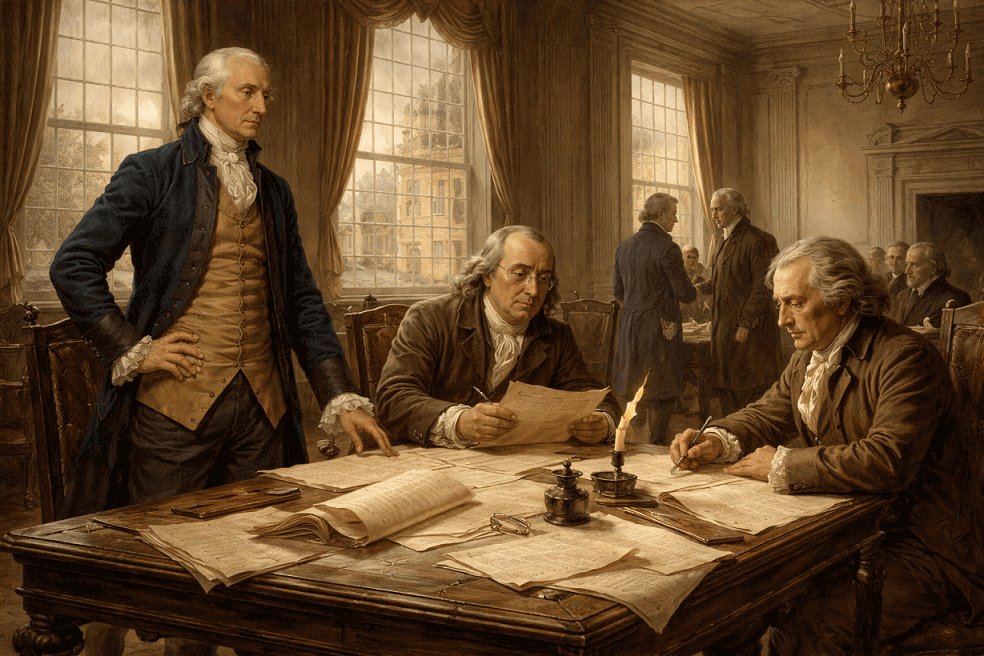
Though much was debated, the Constitutional Convention of 1787 was convened for one purpose: “to secure the blessings of liberty to ourselves and our posterity.”
Supporters and opponents of ratification shared the same Lockean worldview, differing only over which group posed a greater threat to liberty: the wealthy or the democratic mob.
Take Action
To explore more essays, source material, and full links to every episode of the Foundations of Freedom Podcast with Jerome Huyler, visit: www.JeromeHuyler.com .
You’ll also find additional resources that expand on America’s founding principles and their relevance today.
Finally, print and send a letter to your representatives by downloading it here.
If you’d like to go deeper, consider buying Jerome Huyler’s books on Amazon , or send a DM on LinkedIn or Quora to request a free e-copy of the book.
FAQs
What did the Founders mean by “limited government”?
They meant that government could only exercise powers that individuals themselves possessed and knowingly delegated—nothing more.
Was John Locke the primary influence on the Declaration of Independence?
While other thinkers influenced constitutional structure, Locke’s natural-rights philosophy informed the “self-evident” truths affirmed in the Declaration.
Why did the Founders study Montesquieu?
Montesquieu focused on political forms—especially separation of powers—rather than on natural rights themselves.
Did Federalists and Anti-Federalists disagree on natural rights?
Supporters and opponents of ratification shared the same Lockean worldview and differed primarily over which social forces posed the greater threat to liberty.
Where can I find more Foundations of Freedom content?
Visit www.JeromeHuyler.com for links, resources, and access to all podcast episodes and related content.